An open project by Caprey SAS · Argentina
The model is replaceable. Your personal world is not.
What you know lies on cards, each with its source. You and your agents read a situation on one table. People trade cards with each other. There is no central truth and there are no editors: what counts as real in your world is up to you.
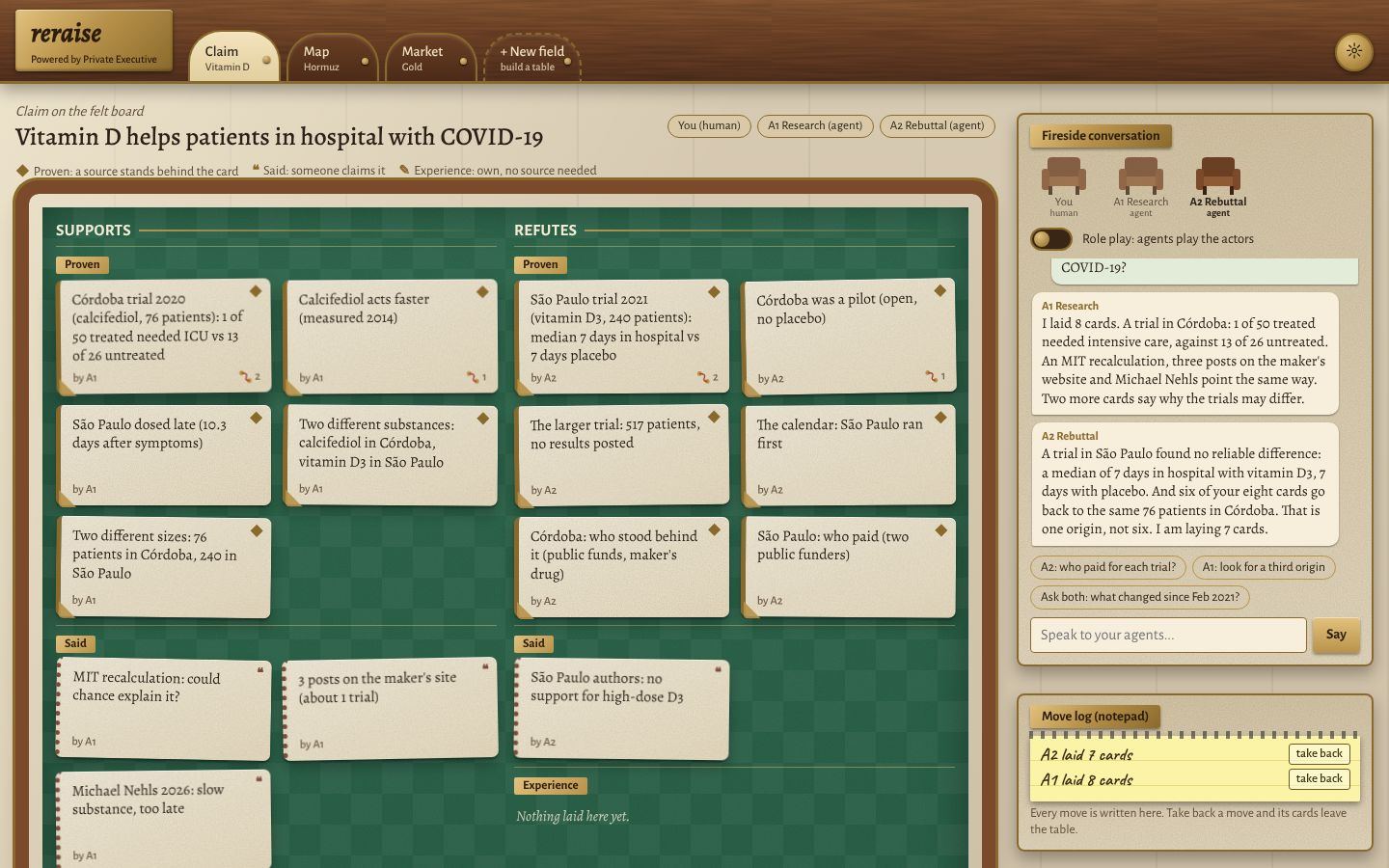
Córdoba trial 2020
Calcifediol, 76 patients: 1 of 50 treated needed intensive care, against 13 of 26 untreated.
SaidMIT recalculation: could chance explain it?
Three posts on the maker’s website argue the Córdoba result is not robust.
ExperienceNothing here yet.
Your own. No source needed.
One question on the board: does vitamin D help patients in hospital with COVID-19? Real cards from the table. The star you set on a card is yours alone and never leaves your device.
· The card
One statement, with where it comes from.
A card keeps three things apart. Whether it is proven, said or your own experience is written on the card and never mixed. Every proven or said card needs a source. The card is one Markdown file with a short header, so it is yours to keep, copy and move. The card format
It traces back to a source or an original. A card is checked for one thing only: does it say what its source says. That is a check of origin, not of truth.
Somebody claimed it. Named, with where and when. A claim is not a fact, and the card never pretends it is.
Something you lived through yourself. It needs no source. It counts because it is yours.
Believed is not a layer. It is your stance on a card, stored apart from the card, on your device, and it never leaves it. Two cards that contradict each other both stay on the table.
· The film
Ninety seconds on why your world should be yours.
The big houses made their bet: that you would hand them your world. The film says in ninety seconds what the reraise is, and what a card changes. The whole idea in twenty short chapters is on the film page.
· The game
Everyone gets a world of their own. And we trade the cards.
Four moves, always the same. Your agents take part as sparring partners: they lay cards, draw connections and answer from them. They propose. You decide. How the layers stack
- 01Bring in.
Write down what you found and what you think you know. Put your sources behind it. Clean sources earn standing: points for origin and proof, never for volume.
- 02Trade.
Swap cards with others on the exchange. The origin stays on every card, so a copy never counts as a second witness.
- 03Decide.
Lay the cards on a board around one question. Supports left, refutes right. A decision becomes a card of its own.
- 04Learn.
Later the outcome is written on the decision card. Sources are weighed by their record and your own experience. No one declares the truth.
· The table
One question on the table, the cards around it, your agents beside you.
The look of the table is your setting, not ours. Five schools of interface design, same cards and same functions: Fireside room, Tabletop, Bauhaus, Canvas, Usability. Every one is a working prototype. Sit at the table · Twelve things you can do there
The health board behind it holds 333 cards on 47 nutrients. Each card was checked against its source by a local model: the quote, every number and the named speaker have to be on the source page. Cards that fail are left out. Board and fields
· The exchange
Bring in what is public. Take what you need.
Every card on the exchange was brought in by a numbered member, with its source behind it. Reading and taking are free for everyone. To bring in a card, you need a number. The first numbers belong to the founders. Get your number · The five rules
Not ready for a number, but you want to hear when something moves, or you have a question for the people who run this: leave a line here. It goes to us, not to a mailing list.
· Open
Nothing is sold here. The code and the format are public.
Your world is a folder, and leaving means taking the folder. Cloud models are allowed by default and you can lock them off. Caprey SAS, in Argentina, runs the project. What is open, and who runs it · How an agent reaches your world
- reraise-appBoard, API and MCP server. Toolkit release 0.2.0. AGPL 3.0.Day-to-day work happens here.
- reraiseCard format v2 and the project documents. Apache 2.0.The home of the open card format.
- troveThe cleanup desk: you and your agents sort mail, drives and files side by side, every step logged.Release 0.3.0.
- reraise-kit-*card-format, knowledge, mcp, claude. Small kits to put cards into any agent.